
Dental CBCT Scan in Chennai, India: What It Is, When You Need It and What to Expect
A standard dental X-ray shows a flat picture of a three-dimensional problem. For many everyday treatments, that is enough. For a root canal that keeps failing, an implant near a nerve, or a jaw that needs surgery, it often is not. That is where a dental CBCT scan comes in.
At Root Canal Foundation in Anna Nagar, Chennai, we have a CBCT scanner in our own clinic, so your scan, diagnosis and treatment plan happen in one place.
What is a dental CBCT scan?
CBCT stands for cone beam computed tomography. The machine rotates around your head once, taking a series of X-ray images, and software builds them into a 3D model of your teeth, jawbone, nerve pathways and sinuses. Your dentist can then look at the area from any angle, in thin slices, instead of relying on one flat image.
It is different from the medical CT scan done in hospitals. A dental CBCT scans a smaller area, is designed for teeth and jaws, and is generally reported to use a lower dose than a conventional medical CT.
| Intraoral X-ray | Panoramic X-ray (OPG) | Dental CBCT | |
|---|---|---|---|
| What you see | 2D view of one or two teeth | 2D overview of both jaws | 3D volume of teeth, bone, nerves and sinuses |
| Best for | Cavities between teeth, bone level around a tooth | General overview, wisdom teeth, jaw screening | Complex root canals, implant planning, surgery, jaw and sinus questions |
| Limitation | Flattens 3D structures into one image | Structures overlap and are distorted | Higher dose than a 2D X-ray, so used only when justified |
When does a CBCT scan help?
Root canal treatment and retreatment
Teeth can have extra or hidden canals, curved roots, cracks, or infection that a flat X-ray cannot show. A 3D scan helps us:
- Find canals that were missed in an earlier root canal
- See the exact size and position of an infection at the root tip
- Plan apical surgery (apicoectomy) when a root canal cannot be fixed from above
- Check how close a tooth root lies to the sinus or to neighbouring roots
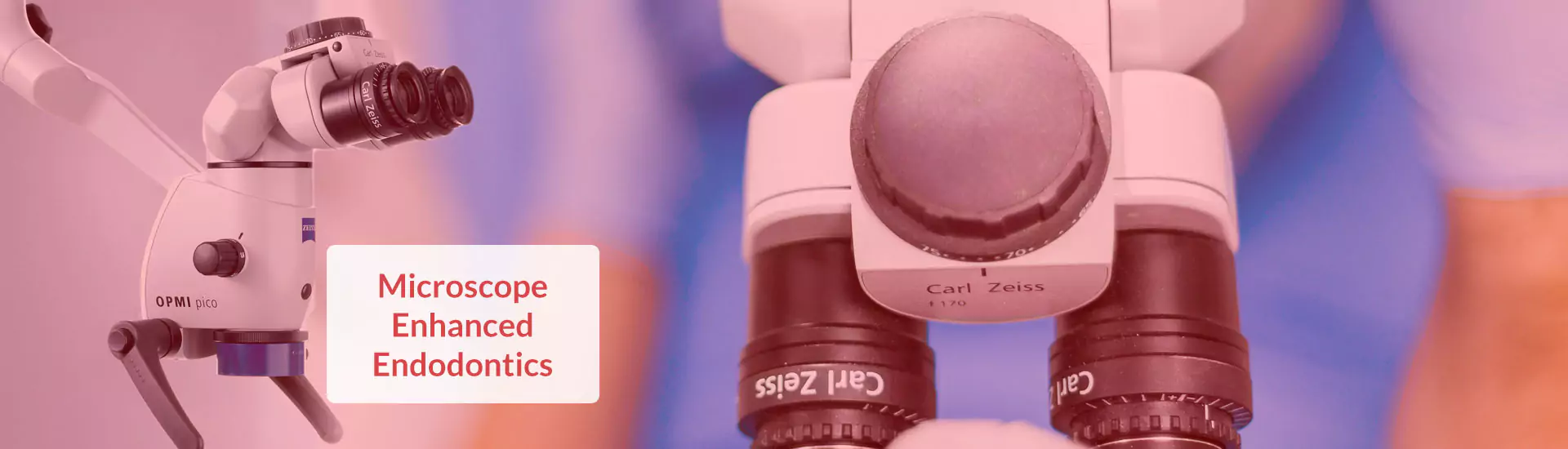
We use the scan together with our dental operating microscopes, so what we see on screen guides what we find in the tooth.
Dental implants
An implant must sit in enough healthy bone, away from nerves and sinuses. CBCT shows bone height, width and density, and where the nerve and sinus lie. We use it for digital 3D planning and to make surgical guides, so that a single implant or a full-arch case such as All-on-4 or All-on-6 is planned before surgery.
Oral surgery, jaw joint and other problems
CBCT is also used for impacted teeth, cysts and other jaw lesions, injuries to teeth and jaws, jaw joint (TMJ) problems, and some sinus questions.
When you probably do not need one
A CBCT scan is a tool for a specific question, not a routine check-up. Ordinary X-rays are usually better for finding decay between teeth, and many simple fillings, cleanings and uncomplicated root canals do not need 3D imaging. We recommend a scan only when it will change how we diagnose or treat you. If it will not, we will tell you.
Our CBCT scanner at Root Canal Foundation
- In-house scanner: Morita X800 CBCT from Japan is one of the global pioneers of dental CBCT scans and is renowned for its small field of view (40mm X 40mm) option that makes it one of the most accurate CBCT machines available for both implant and root canal procedures.
- Same visit: scan, review and discussion at one appointment, with no separate imaging centre
- Specialist reading: images are reviewed by our endodontic, prosthodontic and implant specialists who will treat you
- Joined-up planning: the scan feeds directly into microscope-guided endodontics and digital implant planning with surgical guides
- Targeted scans: we scan only the area we need, using the smallest field that answers the question
What happens during a CBCT scan?
- We explain why the scan is needed and what we hope to learn.
- You remove glasses, jewellery, hearing aids and any other metal around the head and neck.
- You stand or sit with your head supported so it stays still. A lead apron may be used depending on protocol.
- The scanner rotates around your head. This usually takes well under a minute, and you only need to stay still. It is painless, and no injection or dye is used.
- The 3D images appear on screen within minutes, and your specialist goes through them with you.
You can carry on with your day straight afterwards.
Is a CBCT scan safe?
A CBCT scan uses X-rays, which are ionising radiation. The dose depends on the machine, the area scanned and the settings. Published estimates vary, but a small-area dental CBCT is generally reported to give a much lower dose than a medical CT of the head, though more than a single dental X-ray. Dentists follow the ALARA principle, meaning doses are kept as low as reasonably achievable, and a scan is ordered only when the information justifies it.
Tell us if you are or might be pregnant. Dentists commonly advise against a CBCT scan during pregnancy unless it is essential, and we will discuss alternatives. We also take extra care with scans for children.
How much does a CBCT scan cost in Chennai?
At Root Canal Foundation, depending on the field of view you might be charged between INR 2200 – 5000 per scan. We give you a written estimate before any treatment begins.
Frequently asked questions
Is a CBCT scan painful?
No. You only need to stay still for a short time. Nothing goes into your mouth, and no injection is needed.
Do I need a CBCT scan before a root canal?
Not always. Many straightforward root canals are planned with standard X-rays and a dental microscope. We recommend CBCT for complex anatomy, a failed previous root canal, suspected cracks or large infections.
Do I need a CBCT scan for a dental implant?
For most implant cases, yes, because it shows bone and the position of nerves and sinuses. Your surgeon will explain what your case needs.
How long does it take?
The scan itself takes under a minute. Allow a little longer for set-up and a review of your images with the specialist.
Can I get the scan and a second opinion?
Yes. We welcome second opinions, including for root canals that have not healed. Bring your earlier X-rays and reports if you have them.
Can I bring a scan done elsewhere?
Yes, please bring the data file as well as the printed report, if you have it. Whether we need to repeat it depends on its quality and your question.
Book a consultation
If your dentist has advised a CBCT scan, or you have a root canal that has not healed or an implant to plan, we can help. Visit us at Sri Arcade, D Block, Anna Nagar First Main Road, Chennai 600102 (next to Raymond showroom), or message us on WhatsApp for a pre-consultation.
This article is general information and not a substitute for a clinical examination. Whether you need a scan is a decision for you and your dentist.